

Anti-war protests of the 1960s and '70s changed the political face of Ann Arbor
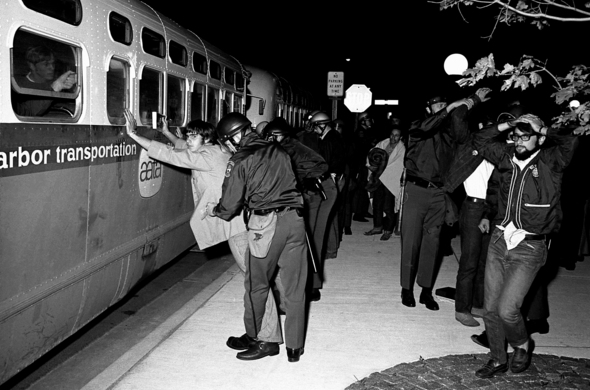
Anti-Vietnam War activists are arrested on Sept. 25, 1969, for taking over U-M's LSCA Building. Police searched the youths before loading them on buses headed to jail.
File photo | AnnArbor.com
Editor’s note: Time magazine recently declared “the protester” as its “Person of the Year” for 2011, citing worldwide protests including the Occupy Wall Street movement. But the modern day protest movement has nothing over the 1960s and ‘70s when America was divided over the war in Vietnam. Ann Arbor played a central role in those times, as regular contributor Robert Faber details in this column.
For many of the last century’s residents of East Coast factory towns, the dream of living in a first-rate university community in the Midwest seemed an unattainable goal. But this is America and you can never aim too high, so in the summer of 1954, I made the move.
As a proud political liberal, the promise of life in a town like Ann Arbor, where the people are educated, smart and, ipso facto, Liberal (as a major university community, after all, how could they be otherwise?) the future was clear and ordained.
It is unlikely I could have been more wrong. Mayor Bill Brown, a Republican stalwart, had been in office for six terms (1945 - 1957) and was now presiding over an almost solid 10-member-plus-mayor Republican City Council -- the single exception being the politically lonely, young Democrat Alicia Dwyer.
In 1957, the university professor Sam Eldersveld won the mayor’s seat, but that revolution lasted no more than a single term. The real and lasting upheaval broke out in the election of April 1969, when out-of-state students were given the right to vote in local elections. And so began the Revolution - Bob Harris, a University of Michigan law professor, was voted in as mayor, I won the traditionally Republican 2nd Ward by an eight-vote landslide, and the two of us were joined by four other Democrats for a solid majority for the first time in 30 years.
But revolutions have a way of encouraging disruption and within a month of that election, Ann Arbor suffered one of its more disquieting upheavals of recent decades: weekend invasions of rock music played at glass-breaking decibels in all of our public parks. While the young embraced that bombardment of their senses, the slightly older population -- those who voted, paid taxes, and used telephones to besiege members of City Council -- remained reluctant captives of the almost physical misery inflicted by this offensive new sound. Within a few weeks almost everyone on City Council had installed an unlisted telephone line in order to avoid some of the violent dinnertime complaints of Ann Arbor’s symphony-oriented older generation. It was a new era in which the nature and limits of behavior were to be set by the rebellious young.
After many weeks of near riots and threats from both the increasingly deaf participants (including the pre-professional Iggy Pop) and their distressed and no less confrontational parents, I was able to meet with Skip Taube, minister of education for John Sinclair’s White Panther Party and spokesman for the insurgents, to seek some sort of common ground to resolve this crisis. The unexpected reality was that they were not particularly interested in revolution, merely the pleasure of playing their own music in their own way.
Despite the continuing antagonism and threats preceding our negotiations, the matter was peacefully resolved by relocating the music sites from mid-city parks to the field bordering Huron High School (comfortably out of range of the city’s residential antagonists) in exchange for an agreement by the bands to limit their volume to 90 decibels - still enough to break glass, but leaving most skulls intact.
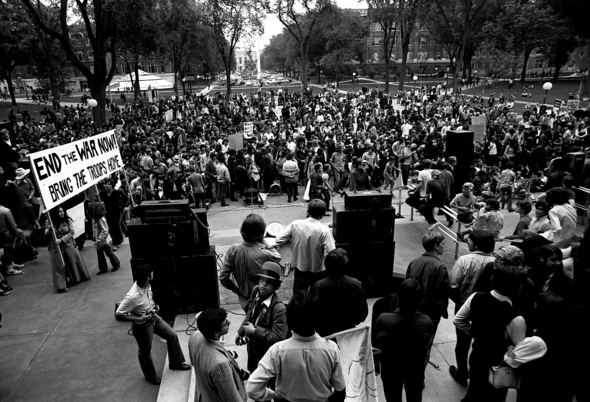
A peace rally draws opponents of the Vietnam War to the University of Michigan campus on Sept. 20, 1969.
File photo | AnnArbor.com
But that was just the beginning. As noted by Bob Dylan during that period, the times they were a-changin’. The face and many of the features of the national scene were becoming more radical, more confrontational, and dangerously tinged by the lure of the commune culture with its promotion of LSD by Timothy Leary’s advice to “Turn on, tune in, drop out.” That new national climate of strident independence was not lost on Ann Arbor, the most disruptive result of which was the week-long turmoil that came to be known as the “South U Riots.”
On the very hot night of June 16, 1969, about 500 U-M students and “street” kids began an unplanned celebration on South University with wine and firecrackers and unrestrained good cheer. In the midst of all this, a motorcyclist engaged in some stunt riding, a dangerous activity on a crowded street, prompting the police to stop him with a ticket. But the party, now energized by the confrontation with the police, continued until about one o’clock in the morning.
The next day the Detroit press and television stations, simply by showing up for a probable “story” created the story, a disruption that necessitated assistance in crowd control from about 300 city, county and state police who used nightsticks, pepper spray and tear gas to dispel an estimated 2,000 rioters. To keep the movement alive, kids the next morning distributed leaflets inviting everybody to party again that night, an invitation too exciting to ignore. The White Panther Party, in coalition with the SDS (Students for a Democratic Society) and Rent Strike Committee, passed out their list of “demands,” including closing South University to traffic and making the street a mall for the young people and putting police under ”Community Control so the Fascist Pigs won’t continue to run amuck.” That night, an estimated 1,500 people showed up. The hard-nosed, confrontational Washtenaw County Sheriff Douglas Harvey established a beachhead at the north end of South University, placing a borrowed army tank in the center of the street, bordered on either side by parallel rows of snarling police dogs.
As an alternative to the violence being stirred by Sheriff Harvey’s “peacekeeping” efforts, the mayor and then University of Michigan President Robben Fleming met with several hundred of the young dissidents in the square behind the Administration Building. The purpose of the meeting was to hear and respond to the complaints and, although predictably raucous and punctuated throughout with catcalls and insults, managed to form a thin thread of communications between the kids and the authorities and helped considerably to calm the tensions. It helped, too, that the presence and performance of a local rock band (I believe it was the MC5, a highly regarded and nationally known rock group) redirected the attention when emotions threatened to get out of control. Finally, the air cooled, the conflict dissipated and the streets returned to the People (well, to some of the People).
‘Reefer madness’
But ending that particular source of vitriol in our city’s affairs did not completely separate us from all the unrest then spreading throughout the country. “Reefer Madness” had by then grown from a movie classic to a community commonplace, with Ann Arbor’s population divided into passionate partisans on both sides of the issue. What the older generation saw as a fruit of the Devil was accepted by the young as a harmless indulgence, not much removed from an occasional glass of wine before dinner.
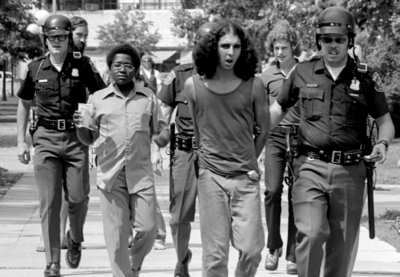
A Hash Bash party at University of Michigan Diag leads to arrests in September 1973.
File photo | AnnArbor.com
Meanwhile, it was inevitable that the changing needs and demands of our increasingly vocal youth would find reflection in the city’s politics, so the Human Rights Party (HRP) was born. The HRP was a new youth-oriented political party of angry dropouts and student antiwar activists whose purpose was more to stir the political pot than to push programs, but their initial impact was the dilution of the Democrat’s majority role on city Council by two, leaving us dependent on their cooperation to get some things done. The reality was that their election had little real impact on the city’s affairs, but it did change the climate in council meetings, leading to many dramatic political confrontations at about 2 o’clock in the morning.
An exception was the $5 marijuana penalty, a compromise between the $9 called for in the Democrats’ ordinance and the 25-cent penalty they proposed. (And for me, sitting between the two HRP Council members, their presence provided an occasional slice of pizza as the pie was passed from one to the other.)
It is of special significance to note that during those several years of political and social turmoil, while most of the country was busy calling out the National Guard to quell assorted scenes of violence, both our city and our university remained reasonably well-ordered and fairly free of dangerous and damaging turbulence. Confrontations between the rebellious youth and the authorities, while raucous and close to constant, were reasonably contained and never violent.
It was telling, for example, that the wild scenes of rebellion that began on South University resulted, not in punitive police action (except for the antics of Sheriff Harvey on that opening day), but in a widely scattered series of community meetings to better ascertain the nature of the problems in order to fashion mutually acceptable changes to calm the discord, and perhaps to design new programs of interest for the young. And while most confrontations were loud and threatening, they were never reduced to violence, either personal or property, providing both the administration and the public an alternative to the dangerous disruptions that were then infecting so many other -- notably university -- communities throughout the nation.
Much of this climate of order and relative calm was doubtless the restraint exhibited by our police under Chief Krasny and by our university leadership. but that in turn was largely a reflection of the character and attitudes of the larger Ann Arbor community.
And that is not a bad characteristic about which a community may boast.
Robert Faber is a regular contributor to AnnArbor.com, writing about aging, politics and other issues. A resident of Ann Arbor since 1954, Faber and his wife, Eunice, owned a fabric store and later a travel agency. He served a couple of terms on the Ann Arbor City Council. He may be reached at rgfaber@comcast.net.
Comments
Bertha Venation
Wed, Feb 29, 2012 : 6:17 p.m.
My brother went to school with Krasney's kid. Ah yes. Those were the good ol' days.... Hey... wanna hit?
Davidian
Fri, Feb 17, 2012 : 4:51 p.m.
For most of my life I have always been fascinated with the counter-culture movement of the 1960s. Even though I think a lot of the more radical elements (ex. SDS) were a bunch of self-righteous jerks, in general the protesters of the 60's really had something to complain about. The author is right: the "occupy" protesters have nothing on the protesters of the 1960s. I'll go a step further and say that the occupy folks are losers that are looking for someone to blame for their failures, while the 60's protesters had specific gripes, goals, aims, plans, and ambitions. And in many cases, they effected positive and lasting change on our society.
Andrew Smith
Fri, Feb 17, 2012 : 12:22 p.m.
I note that a pivotal moment was when out-of-state (or out-of-town) students were given, as a privilege, the right to vote. For a citizen of Ann Arbor, voting is a right and a duty. For someone who is essentially a long-term visitor, any claim to voting is much shakier. A student might spend eight months of the year in Ann Arbor, and those are punctuated with vacations at Thanksgiving, Christmas, etc. Yet these students are elected mayors and city councils who will make significant decisions about roads and building development, decisions which will impact the community for decades to come. I would suggest that students should vote in their own communities, not in Ann Arbor.
justcurious
Sat, Feb 18, 2012 : 1:48 a.m.
It has been proven that it does not take a student mayor or council member to make some really bad decisions...i.e. 1% for Art?, crosswalk laws without correct signage, $750,000 dinky art installations, etc.
genetracy
Thu, Feb 16, 2012 : 4:36 p.m.
I also recall the protests in the early 70's against the communist genocide in Cambodoa. You say the protests did not happen? Never mind, I must have been thinking of something else.
a2citizen
Thu, Feb 16, 2012 : 6:44 p.m.
Darned illiterates. They let anyone be trolling these pages.
genetracy
Thu, Feb 16, 2012 : 4:38 p.m.
Typo alert. I hit the "o" instead of the "i" in Cambodia. Let the name calling begin.
jcj
Thu, Feb 16, 2012 : 4:12 p.m.
Some photos of the times here <a href="http://www.saxpix.com/saxgalleries/historic/index.html" rel='nofollow'>http://www.saxpix.com/saxgalleries/historic/index.html</a> <a href="http://www.modernmajorfilms.com/a2/images/south-u-17.jpg" rel='nofollow'>http://www.modernmajorfilms.com/a2/images/south-u-17.jpg</a> <a href="http://www.annarbor.com/assets_c/2012/01/student-march4_300-thumb-590x385-100952.gif">http://www.annarbor.com/assets_c/2012/01/student-march4_300-thumb-590x385-100952.gif</a>
justcurious
Sat, Feb 18, 2012 : 1:51 a.m.
The Bentley Library site has an extensive collection of photographs from the Michigan Daily.
Doug
Thu, Feb 16, 2012 : 3:01 p.m.
And it's been downhill ever sense!
PLGreen
Thu, Feb 16, 2012 : 2:17 p.m.
Weather you agree with the "antics" used by Sherriff Harvey or not, Sherriff Harvey was the perfect Sherriff for the times. It was because of his "antics" that things were handled by Local Law Enforcement, without the help of the National Guard.
Basic Bob
Mon, Feb 20, 2012 : 5:15 a.m.
Kent State students... attacking guys with M-16's? That would be a spectacularly unintelligent thing to do, and exactly what did not happen. There were no attacks on armed National Guard troops, yet there were innocent students shot, killed, and injured anyway. If you must blame the victims, their mistake was not running away from the ticking time bomb fast enough.
annarbor28
Sat, Feb 18, 2012 : 3:19 a.m.
a2citizen: you are kidding, right? That you think the police at Kent State were attacking the police with guns? They were walking across campus, or some were having a peaceful protest.
librarianne
Sat, Feb 18, 2012 : 12:51 a.m.
WRONG! It was because of President Robin Fleming that the National Guard was not called in.
a2citizen
Thu, Feb 16, 2012 : 4:51 p.m.
justcurious, I'm still trying to figure out how the Kent State students were intelligent enough to get into college. I mean, attacking guys with M-16's is not a sign of intelligence.
justcurious
Thu, Feb 16, 2012 : 3:22 p.m.
Yeah, it's great seeing the photos of the sheriffs with their weapons standing in front of a bunch of dangerous kids with madras shirts and khaki pants and loafers on South U. Not to mention the dogs. Could have easily been another Kent State.
Gorc
Thu, Feb 16, 2012 : 12:56 p.m.
Not only are today's protesters disorganized and ineffective, but there is no music to reflect today's sentiments. The generation of the 60's and early 70's had some of the best music and genuine causes.
Huron74
Thu, Feb 16, 2012 : 5:25 a.m.
Anybody know the names of those two cops in the Hash Bash pic? I think I know one of them. Man does he look young.
bunnyabbot
Thu, Feb 16, 2012 : 4:55 a.m.
I always enjoy stories my grandparents tell me of life during the depression, of how hungry they were as kids living in a tent by the road, then thier lives during the war, WWII. The sacrifices they made, living on rations and small pay, all the while not complaining thier lives were unfair or that they had to work hard, really really hard to have better lives. Now they have interesting lives and stories. The Greatest Generation. Hippies, I don't find them interesting, they were the spoiled baby boomers.
Michigan Man
Thu, Feb 16, 2012 : 4:55 p.m.
A2 - You are correct! Wayne and his beautiful wife are in their early 90"s! Nice story, eh? Did you ever really listen to the MC 5 and/or the UP? Just terrible bands.
a2citizen
Thu, Feb 16, 2012 : 4:49 p.m.
Man, That would be about a 66+ year marriage or a real long courtship.
Michigan Man
Thu, Feb 16, 2012 : 3:46 p.m.
Spoke yesterday at church with a long time old member - he was 20 at the time, on a Naval vessel heading toward Japan, holding for his wife during watch onto a Navy vessel line in a central pacific typhoon thinking he was part of the invasion force of Japan - week later he was part of the flotilla accepting the unconditional surrender of Japan in Tokyo Bay - He cried back in the day and I could see a few tears well up in this eyes yesterday - His wife, who is also still living (married for 50+ years!) smiled at Wayne and patted his back! Who really cares about the MC Five, Minister of Education for the White Panthers Party, etc.
Tru2Blu76
Thu, Feb 16, 2012 : 3:26 a.m.
The central concern in any revolution is: who is running it and why? Every protest group (right and left) likes to compare their movement to that of the colonial rebels of the 1770s. Honestly, that's how delusional people get when they're fed up with something. I turned 21 at the end of 1965. So I got to witness this history of latter day protest movements. Protest movements both pacifist and militant were the fashion. One of my interests has always been history. I guess curiosity is at the root of it all but I think studying history has given me a good perspective. One thing I learned between 1965 and 1970 was: the putative "leaders" of these "revolutions" weren't anything like the leaders of the Independence movement 197 years earlier - and not "in a good way." It all seemed amusing and even hopeful at first, but people NOT in those movements gradually became more and more uneasy when we realized that - there was NO legitimate point being made and no real victories were won for the country as a whole. The anti-war movement was a failure (the war expanded and finally ended only after Nixon sent Kissenger to make a deal with Communist China). More than 10 years of war (counting the period of "military advisors" in Viet Nam). 58,000 American young men died and over 300,000 seriously wounded. An estimated 500,000 "enemy troops" were killed and their side suffered close to a million seriously wounded. The Drug Culture is still treated as a harmless joke - IGNORING - that millions of lives are ruined, countless resources are expended. How many crack babies have to be born, how many young women forced into prostitution to support their habit (and their pimp) - before we take this seriously?
Tru2Blu76
Thu, Feb 16, 2012 : 4:35 p.m.
@justcurious: (1) I MOVED to Ann Arbor in '74, that doesn't in any way show I wasn't HERE before moving my residence. My familiarity with Ann Arbor goes back to 1962! Besides, the "revolution" was played out nationally, so where do you get the idea that residence here is any qualifying factor? (2) Saying that the general population got sick of the ridiculous standoff is "true" but that's my point (which you missed): it was NOT the hippie/peacenik movement which ended the war: it was the pragmatic sense of the far greater (and more responsible) majority. (3) So, you deny that there's a connection between the drug culture and the hippie / peacenik crowd? Then how is it that they became the original & biggest advocates for psychotropic drugs during that time?? All the claims of of the "protesters" from that time are fake. It was always about the "drama" and an excuse NOT to use the tools of the U.S. Constitution to end government misdeeds. It still is: but the current right-wing protesters (aka, "militias") are just another version of losers campaigning for the freedom to celebrate their loserhood. :-)
bedrog
Thu, Feb 16, 2012 : 12:26 p.m.
good comment trublu. As one who is about your age ( and was on the sympathetic edge of the stuff described here) -- and subsequently professionally studied revolutionary movements throughout history and across cultures-- i like to compare them to the role of thermometers in illness. I.e they are an indication a society is sick but if you swallow them they'll make you sicker. Certainly some of the most unconstructively bizarre people around town nowadays ( who blather about 'human rights' while picketing places of worship) seem demographically to be the out of control 'iggy (and pill) poppers' described here , who never recovered either their hearing or their wits.
justcurious
Thu, Feb 16, 2012 : 12:16 p.m.
Sorry, your post is all over the place ..."likes to compare their movement to that of the colonial rebels of the 1770s." What a silly statement that is. You didn't even move to Ann Arbor till 1974, according to your profile on here, so how could you know what people were doing in Ann Arbor's anti-war movement? No, it was not a "fashion" to start saying "Hell no, we won't go". It was a tremendous rising up of the people who were being most effected by it, the young people who wanted their friends and loved ones to stop dying in a no-win war. I'm glad that you were "amused" by it, but you should have been speaking up as well. The people forced the government into ending this debacle. It didn't happen over night, but once mainstream America started joining in, it happened. Now why the heck did you suddenly do the 180 and talk about "The Drug Culture", whatever that is? What does that have to do with the anti-war movement, other than the U.S. Government having looked the other way re: poppy growers in the countries that they occupied? The 60's were the first time that people really started thinking for themselves and realizing that they could not trust their government to do the right thing. Some of us called them on it, others were too busy with their own self interests.
Silly Sally
Thu, Feb 16, 2012 : 11:23 a.m.
Wow, so true! Great points.
Lovaduck
Thu, Feb 16, 2012 : 10:33 a.m.
Excellent and well thought article!
Michigwen
Thu, Feb 16, 2012 : 3:26 a.m.
Bob, your story made me smile, laugh, and cry, remembering our youth.
David Briegel
Thu, Feb 16, 2012 : 2:12 a.m.
What's missing in all this discussion is the fact that America plastered the names of 55,000 of our finest on a black granite wall in DC in the failed attempt to "stop the spread of communism". How'd that work out? What's really sad is the fact that we failed so miserably at our stated objective that we now buy goods manufactured under the very Communist system they sacrificed their lives to stop! American Exceptionalism!
David Briegel
Thu, Feb 16, 2012 : 7:28 p.m.
jcj, wrong again. The Gulf of Tonkin incident was pure fiction. Like WMD's! Sally, when were Republicans ever against war? There was money to be made! If you call delivering a Shiite satelite state to Iran, W was a BIG winner!
jcj
Thu, Feb 16, 2012 : 2:06 p.m.
Just the facts please! <a href="http://history1900s.about.com/od/vietnamwar/a/vietnamwar.htm" rel='nofollow'>http://history1900s.about.com/od/vietnamwar/a/vietnamwar.htm</a> To help prevent Vietnam from becoming a communist country, the U.S. decided to help France defeat Ho and his revolutionaries by sending the French military aid in 1950. When the North Vietnamese fired directly upon two U.S. ships in international waters on August 2 and 4, 1964 (known as the Gulf of Tonkin Incident), Congress responded with the Gulf of Tonkin Resolution. This resolution gave the President the authority to escalate U.S. involvement in Vietnam. President Lyndon Johnson used that authority to order the first U.S. ground troops to Vietnam in March 1965. July 1969 - President Nixon orders the first of many U.S. troop withdrawals from Vietnam.
hut hut
Thu, Feb 16, 2012 : 12:55 p.m.
You're wrong. The US, CIA and military advisors, were in Viet Nam (Indochina) before Kennedy was President.
Silly Sally
Thu, Feb 16, 2012 : 3:50 a.m.
David Briegel is referring to the Viet Nam War, started by a Democratic Congress and President, (JFK & LBJ) with no objective and certainly no real plan to win. Another President, Republican George HW Bush set clear goals and objectives and America did well in Desert Storm. Unfortunately, his son repeated LBJ's Viet Nam War mistakes. While he had a plan to win, and he did, he had no plan about what to do next. The Vietnamese commies are scarred of the Chicom, with whom they fought a war in the late 1970s
Annie Nonmus
Thu, Feb 16, 2012 : 2:09 a.m.
You have GOT to be kidding me. The riots were caused by the news media? C'mom, the punks were causing disruption to the South U corridor. Normal business was impossible. Store windows were broken and stores looted. Sheriff Harvey, being Mr Law & Order stopped them. Good for Sheriff Harvey. We need more like him.
justcurious
Thu, Feb 16, 2012 : 2:31 a.m.
Just like the sports fans have trashed South U on occasion?
crayzee
Thu, Feb 16, 2012 : 12:18 a.m.
Let's not confuse the protest actions of a generation of comfortable kids shaken out of the complacency of the 50s with the bravery and sacrifices of the protesters in places Egypt, Bahrain, and of course especially Syria, where they are risking unspeakable treatment and their very lives to try to create a better future for their kids.
Silly Sally
Thu, Feb 16, 2012 : 3:35 a.m.
Oh, those poor bombing terrorists, who also shoot children. Show them mercy
David Briegel
Thu, Feb 16, 2012 : 2:09 a.m.
Were you lamenting Syria when W and Cheney used Syria to torture their renditioned prisoners? In the name of freedom of course!
hut hut
Thu, Feb 16, 2012 : 1:44 a.m.
I agree completely, but the military industrial machine in the US is far stronger, better funded and more entrenched than any of the thug regimes in the Middle East. Fighting the power here isn't as risky at a personal level as it is in other nations, but it's a far more protracted struggle here in the West that it is anywhere else.
annarboral
Thu, Feb 16, 2012 : 12:17 a.m.
This type of article is a massive distortion of what a relative hand ful of people did that just about everyone else had contempt for. In this case the 1% is the protesters. Everyone else was busy getting an education and preparing to make a tangible contribution to the real world. Why do we continue to glorify people that blow up phone booths and other endearing actions?
Tru2Blu76
Thu, Feb 16, 2012 : 4:59 p.m.
I don't think Faber is distorting so much as he is reminiscing and filling in with some first-hand experience. But I agree with you overall: the anti-war movement wasn't the deciding factor. Scholarly studies of the military draft were published in books long before the "kids" noticed there was a problem with it and started "dramatically" burning what they claimed were their draft cards. Ironic: the draft was ended by an act of Congress, solving the putative problem of involuntary servitude. But even so, the anti-war faction NOW continues to protest even VOLUNTARY service and criticizes those who choose to serve in the military. They're still spitting on soldiers - which apparently is their real purpose in life.
Paul Epstein
Thu, Feb 16, 2012 : 11:24 a.m.
The number of protesters that blew up things and bombed things was probably significantly lower than the number of police and sheriffs who killed and maimed people and fathers who murdered their daughters for not being virgins. Maybe there is a reason Ann Arbor ended up thriving. Because it wasn't as conservative as other places, I'd think. Conservatism usually makes lives worse.
a2citizen
Thu, Feb 16, 2012 : 1:27 a.m.
correction...until April of 1969.
a2citizen
Thu, Feb 16, 2012 : 1:23 a.m.
Justcurious, I would be more impressed had the course war changed before 36,000 Americans were killed. Fact is, there was a monthly increase in troop count until April of 1968. College protesters probably got the most ink when it came to being anti-war. But if the majority of the rest of the country supported the war Johnson would have run for re-election.
justcurious
Thu, Feb 16, 2012 : 12:48 a.m.
Nope, not true. Big changes in society were started right there. Maybe you were busy looking after your own little world in order to make money, but there was a war going on that had been going on since Kennedy's time and we were sick of being fodder. Your probably had your college deferment, the poor didn't. Our action changed the course of that nasty war. Too bad everyone got complacent and allows the rest of them to continue without protest.
BHarding
Thu, Feb 16, 2012 : 12:04 a.m.
I remember those nights. On probably the worst night, I have a sweet memory of being at The Ark, then on Hill St., with the singer calming us with peaceful, hopeful tunes as helicopters were noisy overhead. I'm sure the Siglins remember who was playing, but I only remember the contrast. Everything you ever heard about Sheriff Harvey was true.
jcj
Thu, Feb 16, 2012 : 1:56 p.m.
Paul "and fathers who murdered their daughters for not being virgins" Please help me find references to this happening! As bad as it was this was not a South American tribe!
justcurious
Thu, Feb 16, 2012 : 12:15 a.m.
Harvey's Hotel (The Sheriff Department on Main and Ann St.) was surrounded by Deputies holding german shepards after that night. I guess they thought we were going to storm the place. Later Harvey taught a CDL class.
a2citizen
Wed, Feb 15, 2012 : 11:58 p.m.
Being to young I am just wondering why there was "revolution" in 1957? Sandwiched in between WWII, the Korean War and Viet Nam conflict this appears to have been a relatively peaceful time in our recent history.
jcj
Thu, Feb 16, 2012 : 1:51 p.m.
a2citizen The "revolution" spoken of refers to the electing of a one term Democratic Mayor.
a2scio
Wed, Feb 15, 2012 : 11:13 p.m.
Good story. Thanks. I came to Ann Arbor in the fall of 1972. Times were still exciting. I have a couple questions of fact. If Hash Bash is in April - how were the arrests in Sept.73? Where is the north end of S. University?
jcj
Thu, Feb 16, 2012 : 1:49 p.m.
There is no North end of South U! The house is on the North SIDE of South U!
Silly Sally
Thu, Feb 16, 2012 : 3:33 a.m.
UM President Mary Sue Coleman's House id on the north end of South U Hey HEY! Ho HO! Mary Sue Colemany has got to GO!
Michigan Man
Wed, Feb 15, 2012 : 10:40 p.m.
Many, many inaccuracies in this story - the MC 5 a highly regarded and nationally known rock band? I also was present at the summer 1969 riots and I was not a "street kid" - was in HS and worked at a South U bookstore the entire summer to save money for college. Memory of this author seems to be fading fast!
Paul Epstein
Thu, Feb 16, 2012 : 11:27 a.m.
Actually----the MC5---yes! Known worldwide to be a huge influence, along with the Stooges, for important acts that followed. For those who vilified rock music, sure they were of zero significance. Well, they can't all be Gordon McRae or Gino Vanelli.
beeswing
Thu, Feb 16, 2012 : 12:39 a.m.
They got their picture on the cover of "The Rolling Stone". 1969
justcurious
Wed, Feb 15, 2012 : 11:38 p.m.
I think "kick Out The Jams...." "may" have made the national charts. I was 22 that summer.
Major
Wed, Feb 15, 2012 : 9:42 p.m.
Ah yes, the good ole days of my youth growing up in Ann Arbor. What a time, what a place to be! I sure wish I could find the photo of me helping dig the "bomb crater" at the Rainbow Peoples house during the "Free John" festivities. Darn elusive photo ran in both the AA news and Detroit Free press. Looked in many micro fiche reels, never found it...
jcj
Thu, Feb 16, 2012 : 4:14 p.m.
Major Just for the record we came in from Thompson St!
jcj
Thu, Feb 16, 2012 : 3:54 p.m.
@Major Thanks for the help BUT I remember quite well thank you this particular incident! We forced our way through the students at the entrance at the back of the bldg on the S.W. corner. I was also at the ROTC Bldg next to the dental school the morning they blew the windows out with a bomb. I was remodeling the bldg at the time and got there a couple hours after the bomb went off! So YOU stick to what you saw. BUT don't try to rewrite MY history!
Major
Thu, Feb 16, 2012 : 3:14 p.m.
@ jcj Not at this deal, the whole street was blocked off, so if you had issues getting to work, it was the Harvey gang in your way!
justcurious
Thu, Feb 16, 2012 : 3:11 p.m.
jcj, maybe she should have just taken the day off.
jcj
Thu, Feb 16, 2012 : 1:47 p.m.
juistcurious So you were one of those in the mob I had to push my way through that morning to get my wife to work!
justcurious
Wed, Feb 15, 2012 : 11:36 p.m.
Yes, I agree. There is a picture of me somewhere with my big floppy black hat on, helping to block the cops from entering the LS&A Building. That one appeared in the Detroit News. Another fond memory was painting the Regent's Plaza signs to say People's Plaza with Joe Tiboni. Long bus rides to Washington D.C. with marbles in our pockets. The Blues & Jazz Festivals. Good times...
Top Cat
Wed, Feb 15, 2012 : 9:28 p.m.
Things are different today. Now people only protest wars if there is a Republican in The White House.
Joe Hood
Thu, Feb 16, 2012 : 12:43 a.m.
@Top Cat: Wow, that just hit me. No complaints about the wars, Guantanamo, Patriot Act or much of anything (even the tents in Liberty park were only manned by a non-protesting homeless person). Oh, I'm sure there is a sign or two in front of the post office on Wednesdays but really, where's the spirit?
justcurious
Thu, Feb 16, 2012 : 12:17 a.m.
Actually we protested Lyndon Johnson too. He was a Democrat in case you are too young to remember him.
hut hut
Wed, Feb 15, 2012 : 10:30 p.m.
That's because Democrats pay the bills to get us out of wars that Republicans use the federal credit card to get us into.
Jeff Renner
Wed, Feb 15, 2012 : 9:06 p.m.
My wife and I watched the helicopters over the South U riot from the window of our apartment in University Terrace married housing. I had no inclination to go down there. As I recall, Sheriff Harvey had a cast on his arm, the result of wiping out on his motorcycle on the I-94 curve behind the Westgate Kroger. (The curve was much sharper then.). He gleefully used it as a club on the demonstrators until he beat it into a pulp. Harvey was a piece of work. Until a court order prohibited it, anyone arrested and brought to the jail was immediately given a head shave, ostensibly for health reasons, but clearly to show those long hairs who was boss.
Bertha Venation
Wed, Feb 29, 2012 : 6:18 p.m.
Aw gee. That's right, Jeff! I forgot all about "Harvey's pigs."
Jeff Renner
Sun, Feb 19, 2012 : 10:46 p.m.
@justcurious - You can see his arm in a sling in Andy Sacks' photo at <a href="http://www.saxpix.com/saxgalleries/historic/pages/s511_05.1.html" rel='nofollow'>http://www.saxpix.com/saxgalleries/historic/pages/s511_05.1.html</a>. He was in civvies with a holstered sidearm and and a short barreled riot shotgun, which thankfully, he never fired. I suspect it was loaded with #00 buckshot, though it may have been bird shot.
justcurious
Thu, Feb 16, 2012 : 3:10 p.m.
No cast on his arm in the Michigan Daily photos from the "Riot"
Daisy1
Wed, Feb 15, 2012 : 10:37 p.m.
They had helicopters back then? WOW!!
Mike
Wed, Feb 15, 2012 : 8:54 p.m.
Time magazine recently declared "the protester" as its "Person of the Year" for 2011, citing worldwide protests including the Occupy Wall Street movement. It's really sad that we're now celebrating people like the "occupyers". Many from rich families out stirring up how unfair life is, living off their trust funds, trying to destabilize this country, while the rest of us are going to work every day to pay for basic necessities and trying to keep up with increasing governmental regulatory costs. Taxes, compliance costs, corn being made into ethanol (increasing food prices), parking fees, property taxes, sales taxes, license fees, permit fees, gasoline taxes, cell phone taxes, land line taxes, air bags, anti lock brakes, strip searches at the air port, our tax dollars being pumped into green energy failures, drilling moratoriums for oil causing fuel prices to escalate, being told we have to get used to higher energy costs because coal is bad,..........
Patty Bradley
Wed, Feb 15, 2012 : 8:40 p.m.
Very well-written and compelling story. I would love to read more!
E. Daniel Ayres
Wed, Feb 15, 2012 : 8:40 p.m.
Wow, those were the days, weren't they...
hut hut
Wed, Feb 15, 2012 : 8:04 p.m.
Thanks, Mr Faber. It's good to know local history. This is as much a part of Ann Arbor as is the Allen Creek.